Developing purpose-led organisations
B Corp certification signals that your organisation meets rigorous standards of social and environmental performance, governance and transparency. The certification is granted by B Lab and verified through independent third-party assurance.
In a context of increasing regulatory scrutiny, greenwashing concerns and stakeholder expectations, B Corp provides a structured framework to embed sustainability into core business strategy and decision-making.
From 2026 onwards, B Lab applies a major update to the B Lab Standards. The legacy 80-point scoring system is replaced by clearly defined minimum requirements for each of the seven Impact Topics. Companies must comply with these non-negotiable criteria to achieve certification.
Today, the global B Corp community includes more than 10,000 companies across 100 countries and 160 industries, a strong signal to employees, customers and investors that business can create value for both people and the planet.
What is B Corp certification?
B Corp certification is an integrated business certification issued by B Lab, a non-profit organisation working to create a more inclusive, equitable and regenerative economic system for all.
The certification assesses a company’s social and environmental performance, governance practices and accountability against the B Lab standards. Under the previous framework, companies needed a minimum score of 80 out of 200 points in the B Impact Assessment. Under the updated standards (V2.1), organisations must meet defined performance requirements for each of the seven Impact Topics, verified through independent assurance.
Becoming a certified B Corp demonstrates a commitment to long-term value creation. Balancing financial performance with measurable positive impact on workers, customers, communities and the environment.
Our approach to the B Corp assessment
Sustenuto has been B Corp certified since 2022. Several team members are qualified B Leaders and followed the new European B Corp® consultants Program on the new standards to lead you through the B Corp® certification V2.1.
We support organisations throughout the full certification journey, from eligibility check to recertification, ensuring that the process strengthens governance, strategy and operational performance rather than becoming a standalone compliance exercise.
B Corp feasibility and preparation
We assess whether certification aligns with your strategic ambitions and organisational context under the new B Lab standards. Our support includes:
Clarifying eligibility, entity scoping and sector identification
Completing the Risk Profile assessment
Addressing the Foundational Requirements
Aligning certification with your ESG or sustainability strategy
B Impact Assessment
Under the updated model, the B Impact Assessment functions as a structured diagnostic tool rather than a scoring exercise. We support you in:
Completing and reviewing the B Impact Assessment questionnaire
Prioritising actions per Impact Topic to meet minimum requirements (Year 0, Year 3 and Year 5)
Structuring KPIs, data flows and internal responsibilities
Completing and reviewing the B Impact Assessment questionnaire
The objective is not only to meet requirements, but to strengthen impact management across the organisation.
Governance and integration into decision-making
The revised B Lab standards place strong emphasis on stakeholder governance and accountability.
We support integration at management and board level to ensure that sustainability considerations are embedded into strategic and operational decision-making. This includes:
Engaging top management and board-level stakeholders
Supporting adoption of the B Corp legal requirements
Embedding stakeholder governance principles
Integrating impact considerations into core business processes
Certification submission and verification
We guide organisations through the final stages of the certification process and independent verification. Our role includes:
Documenting policies, procedures and supporting evidence
Preparing internal teams for third-party verification
Providing submission support and follow-up during the audit process
Impact-driven business models
Although Impact Business Models are no longer a formal requirement under the updated standards, they remain a powerful strategic lever. We support organisations in:
Identifying or strengthening impact-driven business models
Substantiating impact claims with robust evidence
Linking impact initiatives to broader sustainability or growth strategies
This ensures that certification is anchored in a coherent business model rather than isolated initiatives.
Post-certification and continuous improvement
Certification is not an endpoint. The updated framework is designed around continuous improvement across a multi-year cycle. We help organisations:
Anticipate Year 3 and Year 5 requirements
Strengthen governance and impact management over time
Prepare for recertification and future standard updates
Structure internal and external communication
Indicative timelines
Preparation to submission
Timelines depend on company size, sector and maturity. Most organisations require several months to address gaps and compile supporting evidence.
From submission to certification
B Lab indicates approximately two to six months for verification, depending on the scope of review and the number of non-conformities identified.
Our international experience
We support organisations pursuing certification across multiple European countries and international contexts.
Our team operates in Belgium, France, Germany, Japan, Portugal and the Netherlands. We are accustomed to coordinating certification trajectories across jurisdictions and languages, facilitating collaboration with local teams and supply chain partners.
What changes under the new B Lab Standards (V2.1)
The updated standards introduce four structural shifts that organisations should anticipate:
Risk Profile Tool and eligibility clarity
The Risk Tool (FR 3.1) tailors due diligence according to sector and operational risk. Certain legacy “controversial issues” are integrated into the Foundational Requirements and risk assessment framework.
The Seven Impact Topics
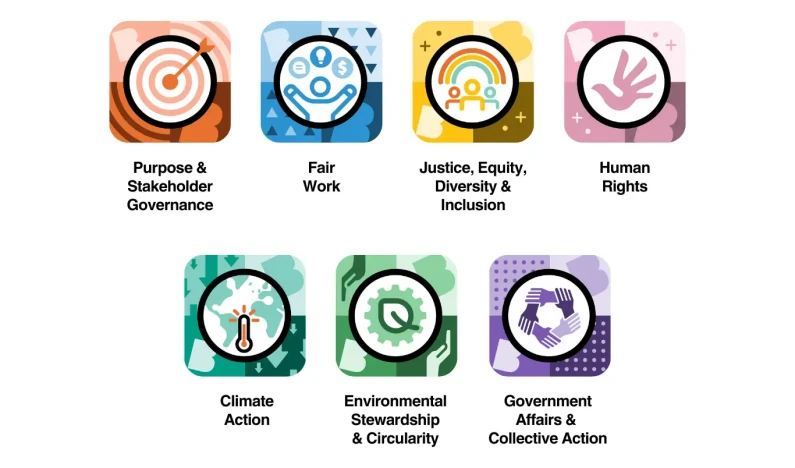
Under the updated standards, companies must meet defined performance requirements in each of the seven impact topics that together cover environmental stewardship, social responsibility and governance (ESG):
Purpose & Stakeholder Governance – embedding legal commitment to mission and stakeholder accountability
Climate Action – aligning with a 1.5°C pathway and strengthening emissions management
Human Rights – identifying and mitigating salient risks across operations and value chains
Fair Work – ensuring job quality, fair wages and worker voice
Environmental Stewardship & Circularity – reducing resource use and environmental impact
Justice, Equity, Diversity & Inclusion (JEDI) – building inclusive and equitable workplaces
Government Affairs & Collective Action – ensuring transparent advocacy and responsible influence
Note for recertifying companies: Impact Business Models are not formally included in V2.1. B Lab may revisit recognition in future updates.
From points to requirements
The former 80-point threshold is replaced by defined minimum performance requirements across each Impact Topic. Companies must comply with these criteria rather than accumulating points.
Phased certification cycle
Requirements are distributed across Year 0 (certification), Year 3 and Year 5, embedding continuous improvement within a five-year cycle.
Independent verification
From 2026 onwards, accredited assurance partners verify evidence and assess non-conformities. B Lab’s Certification Hub provides procedural guidance throughout the process.
Why certification is strategically relevant
Certification has evolved from a signalling mechanism into a strategic governance framework.
The updated standards respond to increasing scrutiny of sustainability claims and provide a credible alternative to fragmented ESG labels or self-declared commitments. By introducing minimum performance requirements and independent verification, the framework strengthens accountability and transparency.
Beyond signalling credibility, the model challenges organisations to reconsider how value is created within the broader economic system. It encourages long-term resilience, stakeholder value creation and alignment between purpose, governance and operations.
For organisations operating in Europe, certification also supports alignment with emerging regulation on transparency, governance and green claims, reducing legal and reputational risk while reinforcing trust among employees, customers and investors.
To avoid having to fulfill multiple assessments, B Corp indicates the questions which meet requirements of EU regulations (e.g.: CSRD, ECGT, CSDDD), standards or other certifications (e.g.: Ecovadis, Fair Trade), among others. The new B Corp standards (v2.1) are intentionally designed to align with ECGT by making it a third-party verified and internationally recognized label.
Frequently asked questions
How long does the b corp certification process take?
The timeline depends on company size, sector and the maturity of existing sustainability practices. Preparation often involves completing the B Impact Assessment, formalising governance structures and compiling supporting documentation.
For many organisations, preparation and verification together require six to twelve months, particularly when structured impact management systems are being developed for the first time.
Do companies need to recertify?
Yes. Certification is not permanent. Under the previous model, companies recertified every three years. Under the updated framework, requirements are phased across Year 0, Year 3 and Year 5, reinforcing continuous improvement.
Recertification ensures that organisations continue to meet evolving standards and remain accountable within the broader B Corp community.
Is certification only relevant for large companies?
No. The framework applies to companies of different sizes and sectors, including small and medium-sized enterprises and family-owned businesses.
Assessment methodology is adapted to organisational complexity. However, all companies must demonstrate measurable social and environmental performance and embed stakeholder governance into their business model.
Does certification replace ESG reporting?
Certification does not replace regulatory reporting or ESG disclosure obligations. Instead, it provides a structured framework that can strengthen data quality, governance processes and accountability across sustainability initiatives.
Many organisations use the B Lab standards as a backbone for integrating ESG priorities into core business strategy.

